How nice to come across a comic book movie soundtrack that revels in melody and mystery, rather than succumbing to simple thumping, percussive elements! James Horner’s score for “The Amazing Spider-Man” also benefits from extended tracks that allow the composer to stretch his themes out and develop them a bit, instead of cutting them off shortly after the two-minute mark, which is generally what happens on another recent soundtrack I received, “Abraham Lincoln: Vampire Hunter,” by Henry Jackman.
Where Jackman’s score does little more than pound or drone, Horner’s “Spider-Man” score takes a theme, played by the trumpet in the opening track, and develops it over the course of the album. The instrument has an inherently heroic quality about it, but here Horner echoes some sense of the isolation Peter Parker must feel as well, away from his birth parents, aloof and apart from his classmates, all while fighting the bad guys as the web-slinging Spider-Man.
Electronics are used throughout the score, either as added percussion, or as a synthesized voice. But they’re only a part of what is mostly a traditional orchestral palette that Horner uses.As a point of comparison, I think Horner’s overuse of synthesized voices in his “Titanic” score sounds dated. Here, not only does the technology of 2012 sound better than 1997, but the synth is not used as the primary voice.
In addition to the main theme, some of my favorite moments in the score include the piano-based “Rooftop Kiss,” and the action scene cue, “Lizard At School!” which, though necessarily intense, never forgets the power of a good melody.
For the past few weeks, I’ve been living with “Prometheus” in my head. Ridley Scott’s not-really-a-prequel (yeah, right) to 1979’s “Alien” has inspired both frustration and fascination on the part of its built-in fan base.And while debating the film’s merits in my own head, I’ve also been listening to the score repeatedly, largely written by Marc Streitenfeld, but with key themes by Harry Gregson-Williams, and even a visit from our old friend Jerry Goldsmith, whose theme from “Alien” is heard during one cue.
Streitenfeld’s music is dark, based around the low strings in the orchestra.Sometimes he opens up the brass section, or augments the score with synthesizers and choirs that howl with strange effects for action scenes.Other times, the music functions more to create atmosphere, reminiscent of the tone clusters of Penderecki. There are occasional plaintive melodies, such as “Invitation,” that hint at the film’s plot, of a tragically misunderstood message, perhaps?
My favorite theme from the film is not actually by Streitenfeld, but Harry Gregson-Williams, whose melody, “Life,” opens with a noble French horn, taken up by the low strings, and carried through with brass, full orchestra, and choir. It’s a majestic piece of music that I think captures the hope and wonder of the two archaeologists who convince billionaire Peter Weyland to fund an expedition to a far-off world that goes horribly wrong.
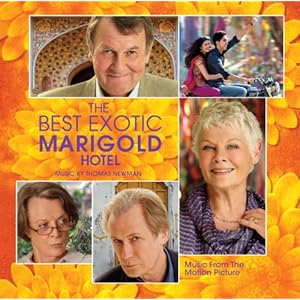
Thomas Newman calls upon local flavor for his score to “The Best Exotic Marigold Hotel,” the sleeper indie hit this spring among the NPR crowd. The film is about a group of seven British retirees that get more than they bargained for when they head off to India for a stay at what they think will be the luxurious Marigold Hotel. Although the hotel turns out to be less than their expectations, all of them are transformed by the cultural immersion of being in Jaipur.
Newman became known in the late 1990s and early 2000s for his quirky scores for projects like Sam Mendes’ film “American Beauty” and the HBO program “Six Feet Under.” The music used tuned percussion and sparse arrangements to create a melodic, yet uneasy, shifty sound.Here, Newman uses Indian vocalists and instrumentalists, as well as strings and rock guitar, in often highly charged tracks. The music befits the uplifting and positive spirit of the story. I’m not enough of an expert to know if it’s authentic Indian, but it captures the flavor of India—or at least, what I would expect it to be!
Maurice Ravel found himself in a position that most artists can relate to. He knew he could create something of value, but at the time Claude Debussy's music was carrying all before it and Ravel wasn't interested in being part of the Debussy parade. The question was could Ravel carve out a place for himself in French music?
In Paul Roberts' new book "Reflections - the piano music of Maurice Ravel" we get a blow by blow account of Ravel's journey from being yet another talented pianist who wanted to compose to one of the leading lights of French Art and someone who's music was now inspiring the aging Claude Debussy - and we get this step by step transformation one keyboard work at a time.
In my radio program The Piano I often try to link the listener in a psychological way to the music by relating what the composer was going through at the time of its composition. Some artists are quite biographical in their works and Roberts gives us a good idea of the psychological landscape Ravel inhabited while creating each piece of music. He reports from letters, on friendships and poetry, normally the symbolist poets that inspired generations of French artists from the mid - nineteenth century through to the Second World War. The author reveals insights from pianists that studied with Ravel and what he passed on to them, such as the initial vision of Ravel provided by the great pianist of the mid twentieth century, Robert Casadesus who passes on what the composer said of his La vallée des cloches (the Valley of the bells) that it was not one bell sounding in a valley but of a metaphorical valley of buildings; this is Paris at noon when all the churches in earshot started ringing their bells and the sensation of those reverberant sounds - some loud and others far away overlapping and filling out the minimalist melodies that Ravel gives us. This is comprehension far beyond a mere translation of the works title.
One brutal insight into Ravel's personality comes out in Roberts' introduction to the book. Ravel had strong views on the people who played his music. He wasn't interesting in having his music - interpreted. In an argument with Paul Wittgenstein the one armed pianist that commissioned Ravel's Concerto for the Left-hand, the performer was defending his re-writing of some passages as saying "Performers music not be slaves" to which Ravel retorted "Performers ARE slaves"; to Ravel literal slaves to the notes and the intent of the composer.
Maurice Ravel was one of the most closed mouthed artists of the day and while you can gain insight into the composer's personal life by reading "Reflections" one will get a better idea of Ravel by reading the new crop of biographies - in English that Roberts recommends in the books preface, like a new biography of the composer by Roger Nichols as well as his "Ravel Remembered".
This is one review copy I will keep and refer to in my up coming programs on the piano music of Ravel. Paul Roberts is just about the perfect writer for this task, a concert pianist and an expert in French music he also wrote "Images" about the piano works of Claude Debussy and after that thorough grounding brings us to that second peak of the French musical landscape in the twentieth century, Maurice Ravel.
The 100th anniversary of the sinking of the RMS Titanic has brought about the rerelease of James Cameron’s masterpiece, “Titanic,” starring Leonardo DiCaprio and Kate Winselt, retrofitted into the 3D format.The soundtrack has been rereleased, too, in a special ‘Anniversary Edition.’
I have seen “Titanic 3D,” and can attest that the film still holds up extraordinarily well as an old-fashioned epic in the best sense of the word. Even in 1997, after Hollywood had long since stopped "making 'em like that anymore," Cameron made a movie like that, and it’s terrific.The 3D is unnecessary, and adds little to the power of the film. However, I admit it’s extremely well-rendered, and doesn’t distract from the narrative, either.
James Horner’s score for “Titanic” won an Oscar, and sold over 26 million albums worldwide. The music lover in me believes also that it wasn’t just because Celine Dion’s megahit “My Heart Will Go On” was embedded on the soundtrack album (this was in the age before iTunes). Horner’s score allowed millions to relive the Romeo and Juliet story on the high seas. Watching the movie again, I felt the score worked.
Stripped of the film, though, some elements of the score don't hold up as well. In the liner notes to the original “Back to Titanic” album (1998), Cameron notes that he wanted the score to be “unconventional and not the classic period score with its sweeping orchestral strings.” Horner’s score does use a traditional orchestra, but also includes Celtic pipes, and pennywhistles. It leans heavily on the voice as a lead instrument, both human and synthesized. It is these wordless, synthetic vocal textures that I feel sinks some of the tracks in the “Titanic” score today. Ironically, instead of creating a timeless score, the electronically created “ahh--ahh” vocal sounds immediately date the music to the mid-to-late 1990s.
The “Anniversary Edition” of the “Titanic” soundtrack includes the full 1997 album, and the welcome addition of fifteen tracks of period music performed by I Salonisti, who not only spent two days recording two dozen numbers from the White Star Line songbook, but they also appeared in the film as the band that went down with the ship.The five-member ensemble performs classical repertoire by Johann Strauss and Peter Ilyich Tchaikovsky, as well as popular hits of the day from operas by Jacques Offenbach and Ivan Caryll, and songwriters like Irving Berlin.More so than Horner’s score, you can put on disc two of the new “Titanic” soundtrack and be transported back in time to 1912, enjoying the finery of Deck A with the likes of Jack, Rose, and the dastardly Cal Hockley, not to mention names like Astor and Guggenheim.
I Salonisti also perform two tracks that were not in the White Star Line songbook, but do feature prominently in the history of the doomed ship.Both “Song of Autumn” and “Nearer My God to Thee” have been cited as the last number played by the band on deck before the ship sank into the north Atlantic on that cold April night.For the movie, James Cameron uses “Nearer My God to Thee,” in what I think is still the most emotional scene in the film. The rendition on disc is the same as heard in “Titanic,” and includes some sound effects at the conclusion, followed by a quote from the film: “Gentlemen, it has been a privilege playing with you tonight.”
This week, a minor controversy erupted online when Kim Novak, star of the 1958 film “Vertigo,” took out an advertisement in Hollywood trade publications to object to “The Artist,” an utterly charming silent film set during the transition from silents to talkies in the late 1920s and early 1930s. In question was the film’s use of the “Love Theme” from “Vertigo,” a music cue so utterly and completely married to Hitchcock’s classic that while I found its use in “The Artist” unobjectionable, I did find myself listening to the music more than watching the movie for a few minutes!
Director Michel Hazanavicius has defended his use of the music, which is unfortunately overshadowing Ludovic Bource’s original music for the film. Bource’s score fills all but four of the tracks on the official soundtrack to “The Artist.” And while the soundtrack does not include the Bernard Herrmann cue from “Vertigo,” a sharp-eared listener will find references to Herrmann’s score for “Citizen Kane,” which are matched visually in the film, itself a loving tribute to the movies.
As befitting a silent film, the soundtrack opens with an overture, and then introduces the characters and setting through melodies that are alternately lush and romantic, or bouncy and jovial, evoking the happy-go-lucky era 1920s Hollywood – or, at least the way we thought it was.
Both “George Valentin” (named for the title character) and the “Fantasie D’Amour” are based on a jazzy riff that’ll put a spring in your step. The “Waltz for Peppy” is love in full bloom. Later in the score, we get to the long, linear lines of “In the Stairs,” as Valentin’s star begins to fade, and his love Peppy Miller ascends to superstardom as a singing, dancing, talking movie star. It’s at the end of this cue that you may hear a faint echo of the opening chords of “Citizen Kane,” by Bernard Herrmann.
As the plot of “The Artist” develops, the music becomes a more urgent. Valentin, obsessed by his inability to keep up with the times, becomes despondent and almost does the unthinkable. His plucky puppy comes through for him, and the film ends with a triumphant dance number. Bource’s music here is reminiscent of the classic big band sound favored by Benny Goodman and Fletcher Henderson, with a touch of Hollywood thrown in.
“The Artist” was one of my favorite movies of 2011, and had me smiling for most of its running time. The soundtrack is equally as magical to listen to!
The fifteen-track soundtrack to director Steve McQueen’s harrowing tale of sexual addiction, “Shame,” carries with it a melancholy mood, despite the appearance of party tunes like the Tom Tom Club’s “Genius of Love” and Blondie’s “Rapture.”
Harry Escott’s original music for the film appears on three tracks, opening the album with the main character’s theme, “Brandon.” Escott’s music is characterized by slow-moving chords and an underlying melody from the low strings. There’s a persistent ticking in the background, and the high strings eventually take over the theme, which lasts about eight minutes. Escott’s music is similarly structured in the cue “Unraveling,” and is limited to solo piano chords for the film’s “End Credits.”
The rest of the album is a mix of sounds that evoke the chilly world of wintertime in New York; Blondie and the Tom Tom Club are joined by Chic and Chet Baker; John Coltrane’s famous “My Favorite Things” is here, but it’s mysteriously upcut by a couple of piano notes by the disc’s sequencing.
Glenn Gould’s marvelous renditions of Bach hold the album together. In the movie, Brandon listens to Gould’s magic even as he sinks further into the abyss.
At the center of this soundtrack is actress Carey Mulligan’s naked rendition of “New York, New York.” The minor key and chromatic piano flourishes give way to a heartbreaking, a capella section as Mulligan struggles to hold the tune through tears, transforming the powerful anthem into a plea. It’s well worth the download (link above, and see trailer below for a sample).
Steven Spielberg has asked John Williams to score almost every single movie he’s ever directed since “Jaws,” which won Mr. Williams his second Oscar, and his first for Best Original Score. It’s a working relationship that has lasted nearly 40 years, and given us some of the most memorable melodies of our time.
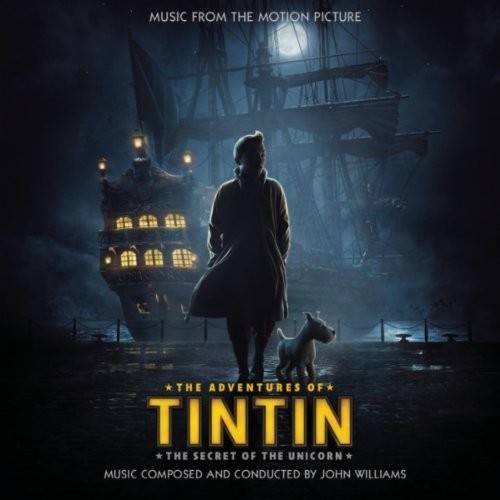
This holiday season, Spielberg is back with an unprecedented feat. He’s releasing two movies right on top of one another. “The Adventures of Tintin,” an animated adventure based on the Belgian comic, opens today, and “War Horse,” a period drama set in England and based on a stage play, opens on Christmas Day. Williams was employed once again to create a unique atmosphere for each film.
Williams’ score for “War Horse” is sequenced on the soundtrack album programmatically. The early cues are pastoral, and evocative of the Dartmoor countryside. The music is ripe with Celtic influences, and a friend of mine even picked out a quote from an old Irish sea chantey. There are few big themes established, but the mood is set as a young boy takes in a steed named Joey. Midway through the album, the mood turns more somber, as Joey is placed into service. A solo trumpet passage is faintly evocative of a similar device in “Saving Private Ryan.” The biggest payoff for Williams fans comes in the final three tracks of the album, “The Reunion,” “Remembering Emilie,” and “The Homecoming.” All three are rich with those big melodies one expects from Williams.
For “The Adventures of Tintin,” Williams calls on his early jazz influences (he once played in a combo as Johnny Williams) and the grand scores of Korngold and Waxman that some say Williams built his career on aping. Personally, I think that Williams has at least distinguished himself from those other composers, even if there is a similarity. “Tintin” opens with a jazzy sound reminiscent of 1950s television sleuths, with a drummer using brushes to keep things hopping. Williams opens the orchestra up to allow unique colors like accordion and harpsichord to steal the spotlight.
I played the second track cold on the day the CD came in to the library at KPAC, and I wasn’t disappointed by the short and sparky “Snowy’s Theme,” representing Tintin’s loyal dog. Vertical runs by the orchestra are echoed by a solo piano at a fast clip. This is “Raiders”-esque high adventure, folks, and it’s a lot of fun.
Williams goes for mystery with some cues, and humor in others, such as a “shattering” guest turn by Renee Fleming.
Both “War Horse” and “Tintin” are welcome additions to the Williams canon, and “War Horse” seems a likely candidate for an Oscar nomination.
“My Week With Marilyn” is drawn from the memoirs of a lowly assistant that shepherded the actress around Britain while she was filming “The Prince and the Showgirl.” The film features a soundtrack largely written by Conrad Pope, but incorporating a main theme written by Alexandre Desplat. Desplat’s music, called “Marilyn’s Theme” on the soundtrack, is built on a rising, then falling five note motif that evokes some of the star’s fragility. Lang Lang performs the solo piano part on the title track, as well as throughout the soundtrack, whenever cues call for the theme to reoccur.
Some of Pope’s music has a churning, buoyant urban restlessness that indicates things are happening on screen. But over time, that sound becomes a little tiresome. I preferred Pope’s quieter, more melodic cues that feature either woodwind soloists playing longer lines, or the aforementioned piano theme by Desplat. One of my favorite tracks is “Arthur’s Notebook.” Arthur, in this case, refers to playwright Arthur Miller, Monroe’s new husband in 1956. He had to leave for work while the two were on honeymoon in England, and Marilyn was left alone.
The soundtrack also includes a few period hits of the time, including Nat King Cole and Dean Martin, and features Michelle Williams vocals on “When Love Goes Wrong, Nothin’ Goes Right,” “That Old Black Magic,” and “I Found A Dream,” by Richard Addinsell (known for his ‘Warsaw Concerto.’). Although no one can match Monroe’s unique voice, Williams holds her own. I suspect the effect works even better on screen!
Listening to modern soundtracks apart from the films they support can be an odd experience. Of three recent acquisitions at KPAC, I’ve only seen one of the films. (It’s tough to get out with kids at home). However, I’m familiar with the material in all three movies. Does that count? I’ve been an X-MEN reader off and on since junior high school, and a Harry Potter fan for many years now. Ironically, of the three movies represented below, I *have* seen “Snow Flower and the Secret Fan.” Still, when I listen to a soundtrack, I’m usually thinking like a radio programmer – or at least a listener, not a film director. Which tracks would I want to hear again?
X-MEN: FIRST CLASS: Henry Jackman
For "X-Men: First Class," the latest film in Marvel’s mutant franchise, director Matthew Vaughn turned back the clock for a prequel about Charles Xavier’s protégés when they were young, gifted students, not yet superheroes. The music is by Henry Jackman, a friend and colleague of Hans Zimmer, with whom he’s collaborated on a number of film scores, including “The Dark Knight” and two of the four “Pirates of the Caribbean” movies. The opening track, “First Class,” sets the high-energy mood with heroic strings that are reminiscent of Daft Punk’s score for “Tron: Legacy.” An electric guitar tears through the mix; I quite enjoyed this music. The electric guitar reappears throughout the score, often providing arpeggios that echo the ticking of time, similar to Zimmer’s score for “Inception.” Other tracks, like “X-Training,” are a little cheesier, with a heavier rock beat and guitars. Much of the music on this disc is built around a six-note motif, including the quieter selections, of which there are few.
HARRY POTTER & THE DEATHLY HALLOWS, PART 2: Alexandre Desplat
This is Alexandre Desplat’s second “Harry Potter” score, following the work he did on “Deathly Hallows, Part 1.” Amazingly, I read that when he was hired for the first film, he had not yet been given a contract for Part 2. It seems to me the continuity between the two films would have been damaged by such a move; but when you think of the Harry Potter saga as a whole, what’s the difference between John Williams writing music for “Sorcerer’s Stone,” Patrick Doyle picking up the baton midway through the series, and Desplat finishing it out? The answer is, a lot. Desplat’s score for “Deathly Hallows Part 2” embraces the dark nature of the plot. Even “Lily’s Theme,” representing Harry’s long dead mother, is a morose lullaby. We do hear some heroics with “Neville,” representing the character who rises to reform Dumbledore’s Army at Hogwarts following Harry’s absence. The magical sound of the celesta, used so memorably by Williams in “Hedwig’s Theme,” appears from time to time, including the “New Headmaster” cue. One of the tracks I enjoyed most was “Severus and Lily,” revealing Snape’s hidden connection to Harry Potter’s past. But overall, there aren’t as many lovely melodies as I would expect from Desplat; perhaps the nature of the story itself has sucked some of the joy from his pen.
SNOW FLOWER AND THE SECRET FAN: Rachel Portman
For the melancholy film “Snow Flower and the Secret Fan,” prolific composer Rachel Portman has written a score that includes Chinese flute, erhu, and pipa, as well as strings and piano. Most of the tracks on the disc work as stand-alone listening experiences. Their song-like melodies evoke both traditional and modern China, as befits the film, which is opens its parallel stories in 1827 and 1997. It's a little hard to listen to the CD all at once, for many of the tracks are musically and tonally similar. But taken a little bit at a time, the “Snow Flower” score is a very pleasing look to the east. Start with “Lily Meets Snow Flower,” and also listen to “Snow Flower’s Tears,” featuring some pretty solo cello.
James Newton Howard’s score for the new film “Water for Elephants” leads the composer down two divergent roads. For most of the score, Howard serenades the listener with brief orchestral fragments. At other times, he’s mimics the big band sound of the 1930s, when the film is set.
Howard is a six-time Academy Award nominee whose best work includes a pounding collaboration with Hans Zimmer for “The Dark Knight” and the score for M. Night Shyamalan’s “The Village,” featuring soloist Hilary Hahn. Most of the cues on “Water for Elephants” are not developed enough into themes that I was able to appreciate apart from the picture, but two selections, “Jacob Sees Marlena,” and “Shooting Star,” are good recommendations for iTunes downloads. Both of those are less atmospheric, more melodic.
Howard’s attempts to write jazzy music of the era are sweet, but lack the passion or fire of the real deal. They feel too Hollywood.
As the approach of the opening of the movie Star Wars: Clone Wars this Friday, I listened with interest to the new soundtrack, featuring the City of Prague Philharmonic with composer Kevin Kiner conducting. It's a must for all Star Wars fans, but not necessarily movie buffs. The new soundtrack is based on themes from John Williams, and is skillfully handled by Kiner. Cues are short, and sometimes memorable. There is also a lot of variety, both with orchestrations (electric guitar, erhu and electronics) and in drama. Throughout the score there is lots of rhythmic propulsion, I think for the upcoming television show, Kiner's music will be far above anything on the small screen, but I'm not convinced how it will play on the silver screen. For the radio and cd player it seems fine! John Clare, KPAC host Listen to excerpts and purchase it here at Amazon.com (and benefit Texas Public Radio.)