A sneak peak for tomorrow's Con amor a San Antonio with Placido Domingo:
Tuesday, May 31, 2011
Placido in San Antonio
 |
| Domingo and Clare |
Tomorrow the San Antonio Opera presents Placido Domingo, Con amor a San Antonio at the AT and T Center. The varied program includes arias, mariachi, zarzuela and more with guest soprano Ana Maria Martinez and a full orchestra.
Host John Clare spoke to Domingo about his lengthy career, new works and returning to San Antonio. Listen to their conversation here. {mp3 file}
Friday, May 27, 2011
Danzones of Arturo Marquez
Danzones of Arturo Marquez on This Week's Itinerarios
Shall we dance? The music will certainly be dancing to the alluring and at times exotic rhythms of the Cuban-Mexican danzon on this week's edition of Itinerarios, KPAC's weekly program of music with Latin American roots. Of course, Marquez' signature Danzon No. 2 will be present, but there will also be the lesser known side of Arturo Marquez, a composer of chamber music, concerted works and, of course, danzones.
Itinerarios airs every Sunday evening at 7 o'clock on Classical Oasis KPAC-88.3fm. Listen online at tpr.org.
ASMFB
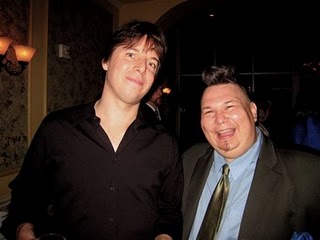 |
| Bell with John Clare after a San Antonio appearance |
Joshua’s appointment is a natural progression of the particularly warm relationship that he has with the musicians of the Academy and UK audiences: “I have felt a particular affection for the Academy of St Martin in the Fields ever since I made my very first concerto recording with them under the baton of Sir Neville Marriner when I was just 18 years old. Since then the orchestra has come to feel like family to me, as we have shared so many cherished moments together both musical and personal. Over the past several years I have begun to explore the great symphonic repertoire with the ASMF and I am thrilled that I will have the opportunity to continue this collaboration under the official title of Music Director.”
The appointment of a Music Director has been made possible financially by the three-year sponsorship from leading global technology company, Siemens. In response to news of the appointment, Andreas J. Goss, Chief Executive, Siemens plc and North West Europe, said: “Our sponsorship of the Academy of St Martin the Fields is an important partnership for Siemens. The Academy is one of the leading chamber orchestras in the world and has achieved its reputation with the pioneering leadership of Sir Neville Marriner. We believe that the appointment of the exceptional violinist, Joshua Bell, as Music Director, will strengthen this world-class position. We have enjoyed working with the Academy and look forward to continuing to support the orchestra as this exciting new chapter in their history unfolds.”
Anna Rowe, Chief Executive of the Academy of St Martin in the Fields said: “This is an extremely exciting appointment for the Orchestra. Joshua is an incredible musician and his work with the orchestra is truly inspirational. We are looking forward to developing the orchestra’s potential with Joshua as our Music Director.”
The recipient of the Avery Fisher Prize and named 2010 Instrumentalist of the Year by Musical America, Joshua Bell has recorded more than 36 CDs and garnered numerous awards including the Mercury, Grammy, Gramophone and Echo Klassik Awards. Joshua came to international prominence at the age of 14 when he made his orchestral debut with the Philadelphia Orchestra at Carnegie Hall under the baton of Riccardo Muti. His breathtaking virtuosity and tone of rare beauty has continued to enchant audiences worldwide for more than two decades. He records exclusively for Sony Classical.
The Academy of St Martin in the Fields is one of the world’s most celebrated chamber orchestras. More than 50 years since its formation, the orchestra continues its relationship with founder Sir Neville Marriner, whose early concerts with the Ensemble were directed from the leader’s chair. More recently the Academy has developed a successful partnership with internationally renowned pianist Murray Perahia, who has been Principal Guest Conductor since 2000. The concept of the conductorless ensemble however has remained the guiding principle of the Academy of St Martin in the Fields’ artistic policy and, over the years, has been strengthened through Artistic Directors, Iona Brown and Kenneth Sillito. The orchestra also performs regularly with violinists Julia Fischer, Julian Rachlin, Janine Jansen and Anthony Marwood, with whom the ensemble has formed strong bonds.
Sir Neville, who in 2009 was given a ‘lifetime achievement’ award at the Grammy’s (and has just celebrated his 87th birthday), is delighted to retain his association with the Academy of which he is now Life President: “The Academy has been the core of my musical life and has given me considerable satisfaction. Since 1986, when Joshua first played with the Ensemble, I recognised in him a kindred spirit, and I am sure he will feel the same as I do about the Academy. His appointment is in tune with the founding principles of the Academy.”
The best of both worlds…

Liszt "borrowed" some of the three handed effects of the piano virtuoso Sigismond Thalberg, when he said to him, "I have copied all your traits" "yes replied Thalberg, there are Thalberg passages in your Norma that are positively indecent!" Liszt was explicit when it came to telling a story in music, he had a way of getting the absolute best out of a melody and when it came to opera his amazing technique and imagination caught fire in a way that could drive an audience wild.
On the Piano this Sunday part two of Liszt at the Opera where the music of Bellini, Verdi, Meyerbeer, Mozart and Wagner get the virtuoso treatment from Franz Liszt. Tune in at 5 this Sunday afternoon on KPAC and KTXI. - host, Randy Anderson
Tuesday, May 24, 2011
Classical Bob Dylan
Today is the 70th birthday of Robert Allen Zimmerman, known as Bob Dylan. A prolific singer/songwriter, poet and painter, Dylan has inspired generations of other artists. A composer who has written music for his poetry is John Corigliano.
Host John Clare spoke to Corigliano about his Mr. Tambourine Man, Seven Poems of Bob Dylan...
John Clare: "Two people I would not put together, Bob Dylan and John Corigliano but there’s a lovely singer involved. How do those inspirations kick start? Was this something that came about with the singer? Was it something that someone said oh, check out these songs?"
John Corigliano: You're talking about Mr. Tambourine Man - a cycle of seven poems of Bob Dylan that I set to music with out any knowledge of his music. And the reason this took place is because Sylvia McNair and Carnegie Hall asked me to write a large song cycle. And Sylvia said really want to be an American writer the poet and I agreed. She said it would be wonderful to get an American who speaks to people today. And you know what? Every great poet speaks to people today, I mean you know Emily Dickenson speaks today. But I thought is there anyone outside of our kind of cultural elite living? Is there someone who speaks to everybody who’s also very, very good? And someone said to me you should check out the lyrics of the song of Bob Dylan because they really poetic and very good. And so I sent for a book of just his lyrics, a big thick book. I went through them and indeed a lot of them were wonderful, some were not, but you know that’s fine. And I went through them and I went through them and I finally put them together into a seven cycle song. The unusual thing and people tend not to believe me in this is that I didn’t really know the music to Mr. Tambourine Man or Blowin' in the Wind. Now when I say that I might have heard it in the sixties or whenever it was done at a coffee shop while I was talking to somebody. But it didn’t pull my ear into its’ world and therefore I never really heard it. I’m not saying this to condemn him because God knows you know he’s considered a great composer by many people and I won’t take that away from them. But it didn’t excite me the way for example the Beatles did. When I heard their music I stopped and there where so many things they would do doing that were really wonderful for the composer...there were interesting harmonically, rhythmically and phase lengths and other ways that I was really fascinated. Never got that from the Dylan songs in those days, so I didn’t know them.
So I took these lyrics or poems - they are wonderful poems, and I was setting them as I would set you know Emily Dickson or Goethe. I was just setting them as a composer of my world setting words I thought were very important. And the result of that was a song cycle that some people love and some people don’t want to hear. I know a lot Dylan people who don’t want to hear this piece. They think it’s strange because we always think of the sacrilegious part - oh say how dare you play Mozart with a pop thing or whatever - and it’s always the classical people. I have found that the folk, pop people can be very ridged about the fact that you are taking Dylan into your world. I don’t think I would have minded if I had a pop version of my music but that’s not what I am. I simply wrote and reflected the words. Another thing about it is Dylan like many folk composers, he wrote an melody and his emotional tale kinda rides over the melody. It isn’t reflected in the melody so he’ll write, he’ll have the same music per verse in which many things happen and many different emotions are displayed - they don’t get reflected in the music.
And I understand that and that’s fine and I appreciate and respect that. But one of the things about art music whether it’s St. Matthew Passion or something else is the idea that these words can be reflected in this music and that’s what I did. So it will be music that will have three different kinds of listeners. One is a novice who will listen to it and say I love these words and I see this music means something or it doesn’t to me. One will be a Dylan supporter who will say I don’t want to hear it because it’s not right to do that. And the third person will be who love Dylan who also get a fascination out of listening to a piece in which both things are happening. That is they hear my piece and they hear Dylan’s piece at the same time. And it’s very interesting for audiences. They really like it...to play these pieces because Blowin in the Wind, they hear the Dylan song and my song at the same timed because they know Dylan so well that when the words happen it just goes into those . But than they hear my cadences and my world and its different and they find that interesting. And I find that interesting abstractly too."
Host John Clare spoke to Corigliano about his Mr. Tambourine Man, Seven Poems of Bob Dylan...
John Clare: "Two people I would not put together, Bob Dylan and John Corigliano but there’s a lovely singer involved. How do those inspirations kick start? Was this something that came about with the singer? Was it something that someone said oh, check out these songs?"
 |
| John Corigliano and John Clare |
So I took these lyrics or poems - they are wonderful poems, and I was setting them as I would set you know Emily Dickson or Goethe. I was just setting them as a composer of my world setting words I thought were very important. And the result of that was a song cycle that some people love and some people don’t want to hear. I know a lot Dylan people who don’t want to hear this piece. They think it’s strange because we always think of the sacrilegious part - oh say how dare you play Mozart with a pop thing or whatever - and it’s always the classical people. I have found that the folk, pop people can be very ridged about the fact that you are taking Dylan into your world. I don’t think I would have minded if I had a pop version of my music but that’s not what I am. I simply wrote and reflected the words. Another thing about it is Dylan like many folk composers, he wrote an melody and his emotional tale kinda rides over the melody. It isn’t reflected in the melody so he’ll write, he’ll have the same music per verse in which many things happen and many different emotions are displayed - they don’t get reflected in the music.
And I understand that and that’s fine and I appreciate and respect that. But one of the things about art music whether it’s St. Matthew Passion or something else is the idea that these words can be reflected in this music and that’s what I did. So it will be music that will have three different kinds of listeners. One is a novice who will listen to it and say I love these words and I see this music means something or it doesn’t to me. One will be a Dylan supporter who will say I don’t want to hear it because it’s not right to do that. And the third person will be who love Dylan who also get a fascination out of listening to a piece in which both things are happening. That is they hear my piece and they hear Dylan’s piece at the same time. And it’s very interesting for audiences. They really like it...to play these pieces because Blowin in the Wind, they hear the Dylan song and my song at the same timed because they know Dylan so well that when the words happen it just goes into those . But than they hear my cadences and my world and its different and they find that interesting. And I find that interesting abstractly too."
Monday, May 23, 2011
They coulda used Biber
It didn't make it to the show, but I'm glad they taped it:
Enjoy Mozart, Bach and Biber on KPAC and KTXI, your classical oasis!
Enjoy Mozart, Bach and Biber on KPAC and KTXI, your classical oasis!
Friday, May 20, 2011
Classical Spotlight: First Look
This weekend the San Antonio Chamber Choir performs a program entitled "Let there be light." A world premiere by Timothy Kramer is a new five movement work called Lux Caelestis. Host John Clare caught some of the dress rehearsal of the new work:
And the best Fingerwork wins

On the Piano this Sunday two young French pianists play the music of Johann Sebastian Bach. From a dazzling Chromatic Fantasy to a beautifully structured Toccata, and the program ends with Bach's own concerto for solo keyboard. Hear Bach a la Francaise this Sunday a 5 on KPAC & KTXI.
host, Randy Anderson
Tuesday, May 17, 2011
Cello there!
Over the past two years, David Finckel has been posting Cello Talks, his innovative, one-of-a-kind series of short videos that cover a remarkably wide range of topics relating to David's vast knowledge of the cello and cello technique. The videos have been filmed on the road by David in a multitude of locations, ranging from Japan to Russia to Scandinavia and even one in-flight from 30,000 up in the sky! Cello talks have attracted an exuberant and devoted following around the globe.
To commemorate the Cello Talks, a website (http://www.cellotalks.com/) has been created where you can search all the videos by topic. The videos can also be found on David and Wu Han's blog, their YouTube and Vimeo channels.
Here is the first one:
Talk 1: Introduction from David Finckel and Wu Han on Vimeo.
And the most recent one:
Talk 100: Bridges and Strings from David Finckel and Wu Han on Vimeo.
To commemorate the Cello Talks, a website (http://www.cellotalks.com/) has been created where you can search all the videos by topic. The videos can also be found on David and Wu Han's blog, their YouTube and Vimeo channels.
Here is the first one:
Talk 1: Introduction from David Finckel and Wu Han on Vimeo.
And the most recent one:
Talk 100: Bridges and Strings from David Finckel and Wu Han on Vimeo.
Subscribe to:
Posts (Atom)