Showing posts with label obit. Show all posts

Monday, April 25, 2011

Another loss

Sad news came Saturday about the death of composer Peter Lieberson.  Much is being written about the composer, a most touching tribute is from Alex Ross:
Lieberson was a magician of harmony. He wrote with a rare combination of modernistic rigor and Romantic sensuality, the latter coming ever more to the fore in recent years. Among his major works are the First Piano Concerto, written for Peter Serkin; Drala, a sumptuous symphony in miniature; the opera Ashoka's Dream, which had its premiere in Santa Fe, in 1997; and the Neruda Songs, the last of which can be heard above. His father was Goddard Lieberson, the mighty president of Columbia Records, his mother the dancer Vera Zorina. He studied composition with the late Milton Babbitt, among others. He was also deeply versed in Tibetan Buddhism, and for a time ran a Buddhist meditation center in Nova Scotia. “What makes the human life so poignant is the recognition of its profound impermanence,’’ he told David Weininger last year.

Wednesday, February 16, 2011

RIP Sidney Harth - Concertmaster, Conductor, Teacher

Read more here: http://www.post-gazette.com/pg/11047/1125789-122.stm
Violinist and conductor SIDNEY HARTH, was universally acclaimed as one of the world's great artists. His prolific career as a performer and educator has earned him countless honors and accolades, and his numerous recordings have made an important contribution to classical discography.
In a stunning musical and political victory, Harth attained international recognition when he became the first American to be awarded the Laureate Prize in Poland's Wieniawshi Violin Competition in 1957 at the height of the Cold War.
Harth's orchestral career was unparalleled. He served as Concertmaster of the New York and Los Angeles Philharmonic Orchestras, both under conductor Zubin Mehta, Concertmaster of the Chicago Symphony Orchestra under Fritz Reiner, and Concertmaster of the Louisville Symphony Orchestra under Robert Whitney, where he was also Assistant Conductor. His solo engagements took him to virtually every musical capital in the world, performing with the major symphony orchestras of North America, Europe, Israel, China, South America, and Russia. Harth was a familiar figure at the leading summer music festivals including the Aspen Music Festival, the Banff Music Festival, the Vancouver Summer Festival, the Grands Interprets dans le Valle du Lot in France, and the popular festivals in Santa Barbara, Maine, Alaska, Texas, and Tennessee.
In tandum with his solo engagements, Harth enjoyed a brilliant career as a conductor. His numerous appointments have included the post of Associate Conductor of the Los Angeles Philharmonic, Music Director of the Jerusalem Symphony Orchestra, the Puerto Rico Symphony Orchestra, and the Northwest Chamber Orchestra of Seattle, and Principal Conductor of the Natal Symphony Orchestra in South Africa. He has served as director of the conducting programs at Mannes College of Music in New York, the University of Texas in Houston, and the Hartt College of Music at the University of Connecticut in Hartford. He served as Director of Orchestral Activities at Duquesne University in Pittsburgh, Pennsylvania.
Sidney Harth's notable academic career was marked by his appointment as the Andrew W. Mellon Permanent Professor of Music at Carnegie Mellon University, where he was also the Music Department Head, and Professor of Violin at Yale University for 17 years.
Saturday, February 5, 2011

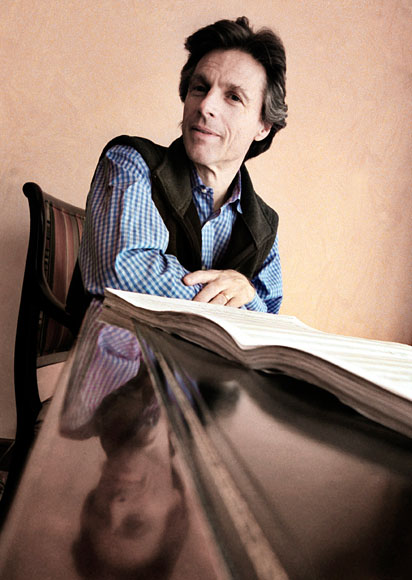
Composer Milton Babbitt

Host John Clare shares his interview and memories of the late Milton Babbitt. Read it here, including an unedited interview, outtakes and video.
More about Milton from his publisher G Schirmer: The compositional and intellectual wisdom of Milton Babbitt influenced a wide range of contemporary musicians. His broad array of distinguished musical achievements in the dodecaphonic system and important writings on the subject generated increased understanding and integration of serialist language into the eclectic musical styles of the late 20th century. Babbitt was also renowned for his great talent and instinct for jazz and his astonishing command of American popular music. His All Set, for jazz ensemble, reveals an extraordinary compositional flexibility, uniquely American and vintage Babbitt.
Babbitt, born on 10 May 1916 in Philadelphia, studied composition privately with Roger Sessions. He earned degrees from New York and Princeton Universities and was awarded honorary degrees from Middlebury College, Swarthmore College, New York University, the New England Conservatory, University of Glasgow, and Northwestern University. He taught at Princeton and The Juilliard School.
An extensive catalogue of works for multiple combinations of instruments and voice along with his pioneering achievements in synthesized sound made Babbitt one of the most celebrated of 20th-century composers. He was a founder and member of the Committee of Direction for the Electronic Music Center of Columbia-Princeton Universities and a member of the Editorial Board of Perspectives of New Music. The recipient of numerous honors, commissions, and awards, including a MacArthur Fellowship and a Pulitzer Prize Citation for his "life's work as a distinguished and seminal American composer," Babbitt was a member of the American Academy of Arts and Letters and a Fellow of the American Academy of Arts and Sciences.
There are also great resources from NPR, American Music Center and more.

Monday, October 11, 2010

RIP Joan Sutherland

Australian soprano Joan Sutherland was described as `La Stupenda', the `Koloraturwunder' or `The Incomparable'. Her career stretched over more than forty years and the many honours she has received all over the world includes the 1979 title of Dame of the British Empire conferred by Queen Elizabeth II.

Sutherland was on the stage since 1947. In Sydney she sang the title role in Purcell's Dido and Aeneas, followed by performances in Handel's Samson and as Judith in Eugene Goossens' opera of that name. Her European career began in London in 1952 (including the part of Giorgetta in Puccini's Il tabarro at the Royal College of Music) and in the same year she also made her debut at the Royal Opera House Covent Garden as the First Lady in The Magic Flute. Before appearing in front of highly critical London audiences in a leading role, as Amelia in Un ballo in maschera, she sang the parts of the Priestess in Aida and Clotilde with Callas in Norma. Even at this early stage this exceptionally gifted soprano demonstrated her range as the Countess in Figaro, but she had to wait another year for her next leading role, during which time she sang the Overseer in Elektra, Lady Rich in Britten's Gloriana, Frasquita in Carmen and Helmwige in Die Walküre at Covent Garden and with the company on tour. Her most important parts in 1954 were Aida and Agathe, in addition to which she was still performing smaller roles such as Woglinde and the Wood Bird. Surprisingly this soprano who has for so long tended towards coloratura, originally appeared in Tales of Hoffmann, not as Olympia, but as Antonia and Giulietta; it was fifteen years later (in Seattle in 1970) that she sang all four female parts in Offenbach's opera -- an achievement captured by DECCA in a complete recording made in the following year.

Dame Joan Sutherland has died in Switzerland at the age of 83, according to published reports. She won the 1981 Grammy Award for Best Classical Vocalist. In 1988, she wrote her autobiography, A Prima Donna's Progress.
Among her honors are a Companion of the Order of Australia, and the Order of Merit. She is survived by her husband, Australian conductor and pianist Richard Bonynge, whom she married in 1954, and their son, Adam.

Wednesday, July 14, 2010

RIP, Charles Mackerras

Sad news of the passing of Sir Charles Mackerras from his family on July 14, 2010.

The American-born (of Australian parents) Australian conductor, (Alan) Charles (MacLaurin) Mackerras, was taken to Sydney, Australia, as an infant. He was born November 17, 1925 in Schenectady, New York, USA. Charles studied oboe, piano, and composition at the New South Wales State Conservatorium of Music. Then he was principal oboist in the Sydney Symphony Orchestra (1943-1946). Subsequently he went to London, where he joined the orchestra at Sadler's Wells and studied conducting with Michael Mudie. He won a British Council Scholarship in 1947, which enabled him to study conducting with Václav Talich at the Prague Academy of Music.

Returning to London in 1948, Charles Mackerras was an assistant conductor at Sadler's Wells until 1953. The he was engaged as principal conductor of the BBC Concert Orchestra (1954-1956). Subsequently he appeared as a guest conductor with British orchestras, and also had engagements on the Continent. In 1963 he made his debut at London's Covent Garden conducting Shostakovich's Katerina Izmailova. From 1966 to 1970 he held the post of 1st conductor at the Hamburg State Opera. In 1970 he became music director at the Sadler's Wells Opera (renamed the English National Opera in 1974), a position he held until 1978. In October 1972 he made his Metropolitan Opera debut in New York conducting Gluck's Orfeo et Euridice. From 1976 to 1979 he was chief guest conductor of the BBC Symphony Orchestra in London. After serving as chief conductor of the Sydney (Australia) Symphony Orchestra (1982-1985), he was artistic director of the Welsh National Opera in Cardiff (1987-1992). He was principal guest conductor of the Scottish Chamber Orchestra in Glasgow (from 1992). In February 1993, Sir Charles was appointed Principal Guest Conductor of the Royal Philharmonic Orchestra in London and later conducted its first professional performance in the UK of the "original version" of Glagolitic Mass with the Brighton Festival Chorus at the Royal Festival Hall. In 1993 he was also appointed Principal Guest Conductor of the San Francisco Opera.

Charles Mackerras has distinguished himself as an opera conductor by championing the works of Janáček. He is a specialist in the Czech repertory, notably Janáček. He has also conducted operas by Georg Frideric Handel, Glück, and Johann Christian Bach. He likewise is a discriminating interpreter of the orchestral repertoire.

Charles Mackerras has undertaken a great deal of research into performance practice of the 18th and 19th centuries. One of the highlights of the 1991 season was the reopening of the Estates Theatre in Prague, scene of the original premiere of Don Giovanni, in which Sir Charles conducted a new production of that opera to mark the bicentenary of Mozart's death. He has recorded all the symphonies and serenades of Mozart with the Prague Chamber orchestra for Telarc, and since becoming Principal Guest Conductor of the Scottish Chamber Orchestra has recorded The Magic Flute, Cosi fan tutte, Le Nozze Di Figaro, and in 1999, a new performance of Abduction from the Seraglio, which, in a joint production with the BBC and Antelope Productions, was filmed on location at the Topkapi Palace in Istanbul. The new recording is scheduled for release in June 2000.

Charles Mackerras has for many years been associated with the Royal Opera House and he returns to Covent Garden in 1999-2000 to conduct Romeo et Juliet and Martinu’s The Greek Passion. In addition to his many appearances with the San Francisco Opera, he conducts regularly at the Metropolitan Opera, New York, where his recent appearances include The Makropulos Case, Katya Kabanova, Die Zauberflöte, and Lucia di Lammermoor. He made one of his many visits to Australia last year to conduct Opera Australia in a new production of Jenufa. He also made his debut at the Salzburg Festival conducting hugely successful performances of Le Nozze di Figaro with the Vienna Philharmonic Orchestra.

Charles Mackerras has recorded a cycle of his operas with the Vienna Philharmonic. His vast discography includes an award-winning cycle of Janáček operas with the Vienna Philharmonic Orchestra, Benjamin Britten’s Gloriana (awarded Gramophone Magazine’s Best Opera Recording for 1994), and Dvorak’s Rusalka with the Czech Philharmonic Orchestra. Notable are his recent highly acclaimed recordings of the Brahms symphonies and serenades with the Scottish Chamber Orchestra for Telarc.

Charles Mackerras was made a Commander of the Order of the British Empire in 1974, and was knighted in 1979 for his services to music. At the end of 1996 he received the Medal of Merit from the Czech Republic, and last year he was made a Companion of the Order of Australia. He is a DMus (hon) of the Universities of Hull, York, Nottingham, Brno in the Czech Republic, Griffith in Brisbane, Australia, and Oxford. Sir Charles celebrated his seventieth birthday in 1995 with gala concerts with the Scottish Chamber Orchestra in Edinburgh, Welsh National Opera in Cardiff and with San Francisco Opera.

Monday, February 2, 2009

Remembering Lukas Foss

Lukas Foss, a prolific and versatile composer who was also a respected pianist and conductor, died at his home in Manhattan yesterday. He was 86. His wife, Cornelia, announced his death.
Mr. Foss was born Lukas Fuchs in Berlin, the son of a lawyer and a painter. The date was probably Aug. 15, 1922, although in 1997, when he was honored with several concerts of his music on his 75th birthday, he said that he was not entirely sure when he was born.
When the Nazis came to power, in 1933, the family fled to Paris, where Mr. Foss enrolled at the Conservatoire and studied piano with Lazare Lévy, flute with Louis Moyse, composition with Noël Gallon and orchestration with Felix Wolfes.
After his arrival in the United States, in 1937, he continued his studies at the Curtis Institute of Music in Philadelphia. The pianist Isabelle Vengerova, the conductor Fritz Reiner and the composers Rosario Scalero and Randall Thompson were his principal teachers. After his graduation in 1940, he pursued further studies in conducting with Serge Koussevitzky at Tanglewood and in composition with Paul Hindemith at Yale. He became an American citizen in 1942.
There's a complete obituary here at the NY Times.
Listen for his Renaissance Concerto from 1990 this afternoon on KPAC and KTXI.

Tuesday, August 12, 2008

Composer News: Donald Erb

Donald Erb, longtime composition teacher at the Cleveland Institute of Music has passed away.
Of his music, Mr. Erb has said: "A craftsman can create entertainment, but you need more than that to create art. You need an emotional, inspirational quality, because in and of itself craft means nothing. There has to be something inside you pushing out or all a person will ever write is a craftsman-like piece. And that's not quite good enough."
Described by Nicolas Slonimsky in the Baker's Biographical Dictionary of Musicians as a "significant American composer," Donald Erb was born in Youngstown, Ohio in 1927. His orchestral music has been played by literally every major orchestra in the United States and by many eminent ensembles in Europe and Australia. He has received major commissions from the Dallas Symphony and the Houston Symphony, among many others. His composition The Seventh Trumpet has been performed more than two hundred times by over fifty orchestras in the United States and abroad, and was chosen as the United States representative to UNESCO in 1970.
Erb's notable students include Margaret Brouwer, John Mackey, Nickitas J. Demos, and Jerod Impichchaachaaha' Tate, Christopher Kaufman, Kathryn Alexander, Kenneth Durling, John S. Hilliard, and James Mobberly.
Hear some of his music online at Art of States.